
Fast Sedans
A fast sedan is a family car with a second job. Here is how the idea grew from a few hand-built German specials into 1,000 hp electric four-doors, and the cars that made each step.
What makes a fast sedan
The rules are simple. Four doors, room for adults in the back, a trunk you can use, and performance that would embarrass a sports car of the same years. The best of them also look ordinary enough to park outside an office. That last part matters: the appeal of a fast sedan has always been the distance between what it looks like and what it can do.
Tuners and the first fast sedans
In the 1970s the fastest four-doors came from tuning firms rather than car makers. Alpina in Buchloe built turbocharged and big-engined BMWs, such as the B7 Turbo on the E12 5 Series, and AMG in Affalterbach was preparing Mercedes-Benz sedans for racing and for wealthy private customers. These were small-volume cars, sold through a handful of dealers. They proved that people would pay for a sedan that went like a GT car.
BMW M5: the official fast sedan
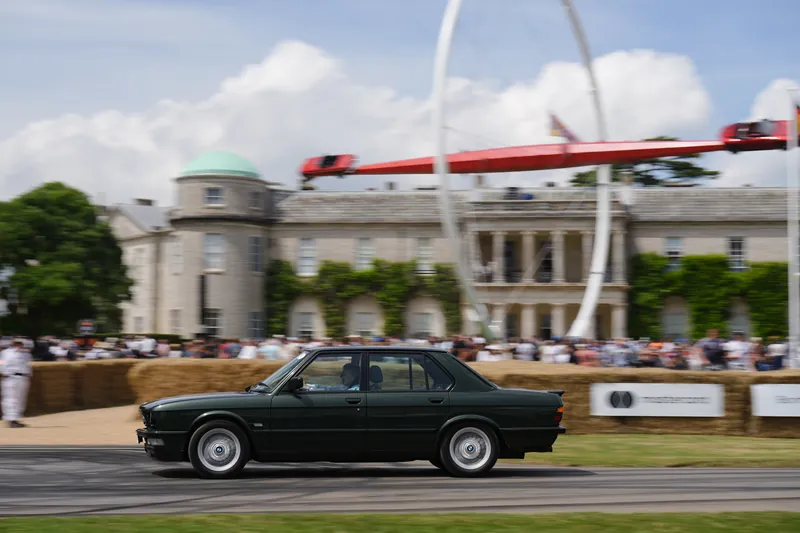
BMW Motorsport GmbH turned the idea into a catalog model. The first M5, launched on the E28 5 Series in October 1984, used the 24-valve straight-six from the M1 supercar. It made 286 hp, reached 100 km/h in 6.1 seconds and ran on to 245 km/h 1. BMW still calls it the fastest series-production four-door sedan of its time 2. It cost DM 80,750 1. The E28 is on the BMW M5 page. The E39 has its own page, with the E34.
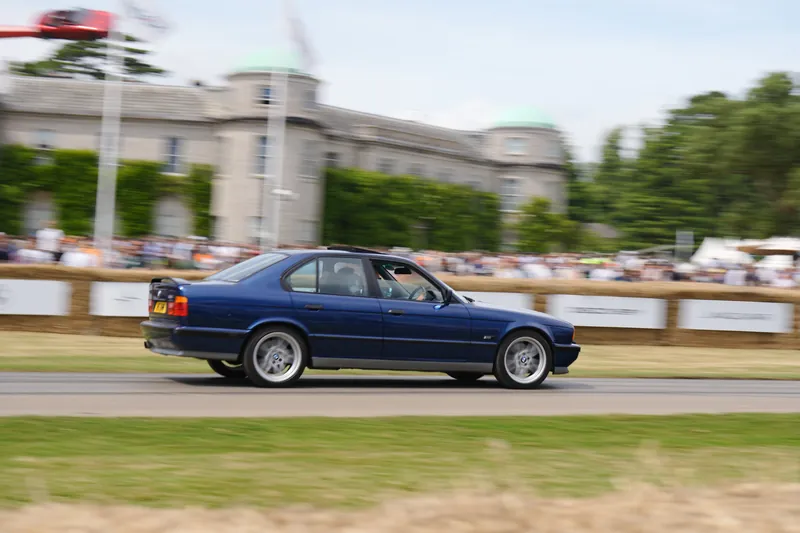
The E34 M5 that followed in 1988 was hand-built at Garching with a 3.6- then 3.8-liter straight-six. The V8 came later, with the E39. The E34 was also the first M wagon. It had 315 hp from 3.5 liters, then 340 hp from 3.8 liters, which BMW says made it the most powerful series-production sedan in Germany that year 3. In July 1990 Car and Driver measured a US 3.6 at 5.6 seconds to 60 mph and called it "the quickest and fastest regular-production four-door automobile this magazine has ever tested" 4. The E34 was finished by hand at BMW Motorsport's Garching works 5, and the class had its benchmark.
Lotus Carlton: the fast sedan in the news
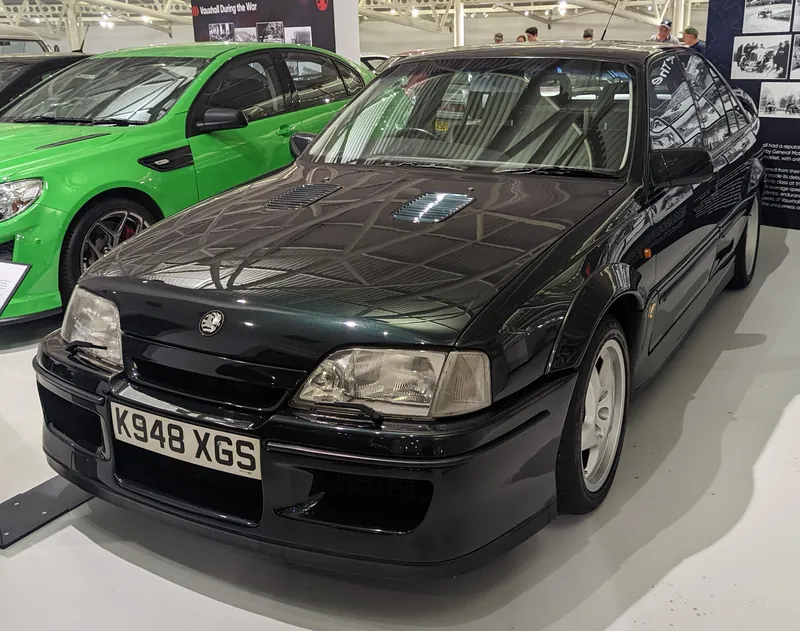
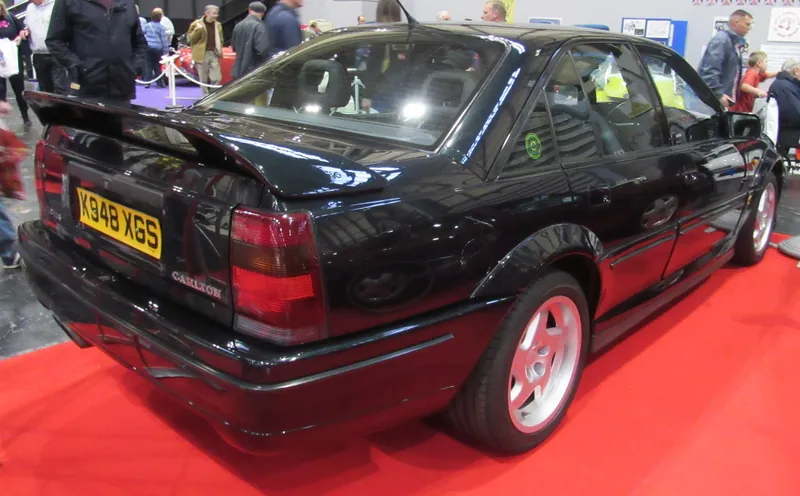
The car that made the fast sedan front-page news was a Vauxhall. Lotus, then owned by General Motors, took the Carlton (the Opel Omega in Europe) and gave its 3.6-liter straight-six two Garrett T25 turbochargers. The result had 377 bhp, 419 lb ft and a six-speed gearbox, and was quoted at 0–62 mph in 5.4 seconds and 176 mph 6,7. Lotus built the cars at Hethel and engineered the suspension 6. Every one was painted Imperial Green, and about 950 were built in total 7. Only 286 were sold in the UK, at £48,000 6.
The Carlton had no speed limiter, and that caused trouble. Vauxhall's own history notes that its speed prompted a debate in the House of Commons 6. The German makers had by then agreed to limit their cars to 250 km/h. The Carlton ran on to 176 mph, or 283 km/h in the figure Lotus gives today 7, more than 30 km/h beyond that line.
Mercedes-Benz 500E: Porsche builds a sedan
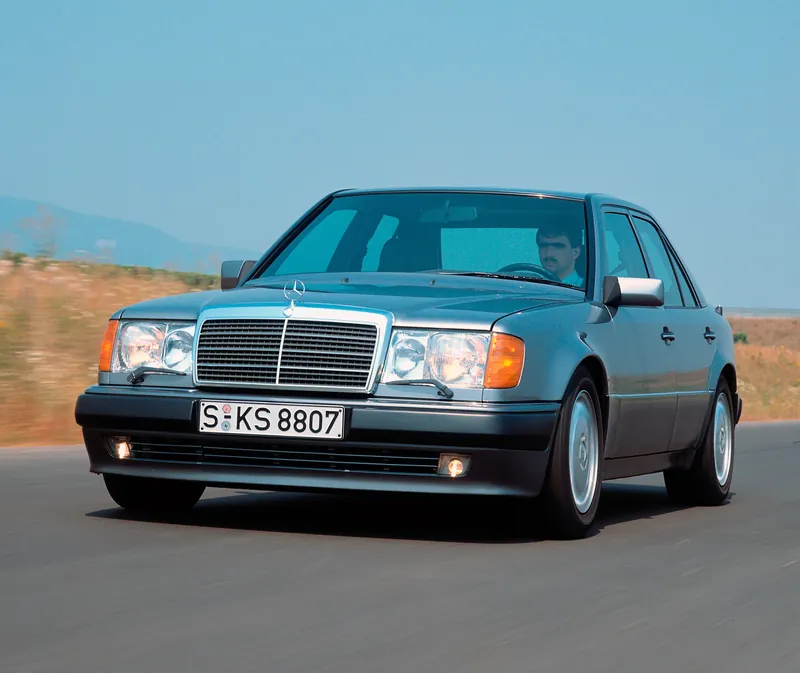
Mercedes-Benz answered with a car it did not build alone. In 1988 it asked Porsche to put the 5.0-liter V8 from the SL into the W124 E-Class 8. The 500E, Porsche Project 2758, was shown in Paris in 1990 and went on sale in spring 1991 8. Its body was 56 mm wider and 23 mm lower than a normal W124, and it seated four 8. Each car crossed between Porsche in Zuffenhausen and Mercedes in Sindelfingen twice: Porsche assembled the bodies, Mercedes painted them, and Porsche did final assembly. A car took 18 days to build 8. With 326 PS and 480 Nm it reached 100 km/h in 6.1 seconds, and its top speed was limited to 250 km/h 8. It was renamed E 500 in 1993, and 10,479 had been built when production ended in April 1995 8.
Car and Driver compared the 500E, the E34 M5 and the Audi S4 in April 1992. The BMW won by one point 9.
Audi RS2 and four-wheel-drive sedans
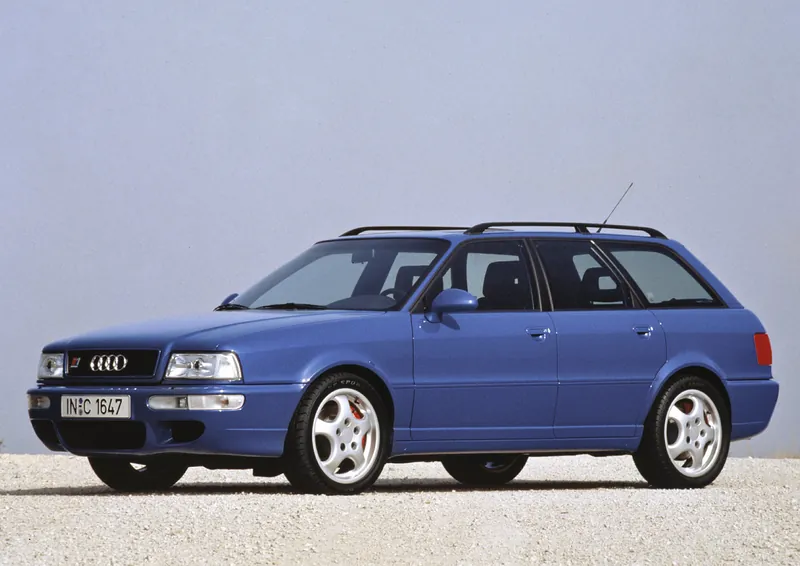
Audi showed that the formula did not need rear-wheel drive or a sedan body. The RS2 Avant of 1994, developed with Porsche and built in its Rössle works, had a 2.2-liter turbocharged five-cylinder with 315 PS. Porsche says it reached 100 km/h in 5.4 seconds and 262 km/h, which made it the world's fastest wagon car 10. Only 2,891 were made 10. Its successor, the RS4 Avant, and later the RS6, turned the fast Audi wagon into a permanent line.
Japan produced its own variations. The Subaru Legacy and Impreza WRX, the Mitsubishi Galant VR-4 and the Lancer Evolution were four-door sedans with rally-bred turbocharged engines and four-wheel drive. Nissan's Skyline GT-R was a coupé, but its RB26 engine also went into the Autech Stagea 260RS wagon.
Fast sedans in the V8 era
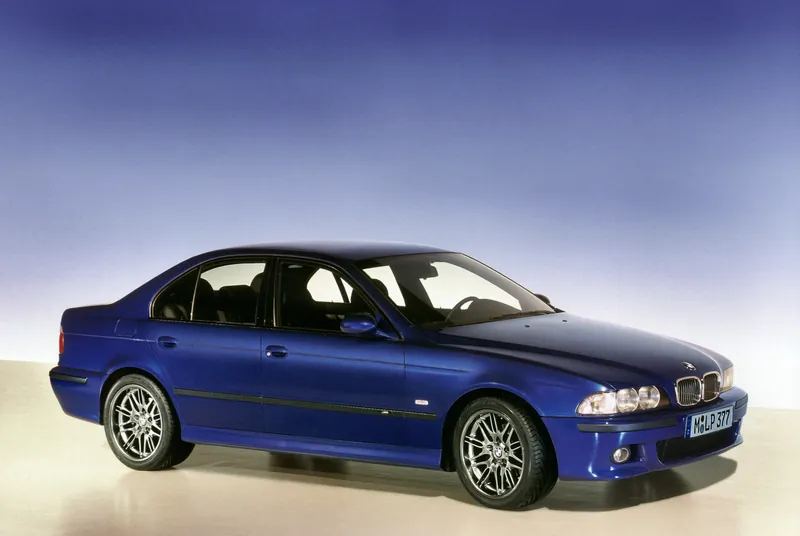
In 1998 the E39 M5 moved to a V8, BMW's first in an M car: 4.9 liters and 400 hp, with 0–100 km/h in 5.3 seconds. It cost DM 140,000 11. AMG, now owned by Mercedes-Benz, answered with ever-larger V8s in the E55 and E63. Jaguar, Cadillac, Chrysler and Holden's HSV all built sedans with around 400 hp for buyers who wanted the performance without the German price. The fast sedan was no longer rare. It was a segment, and every premium brand needed one.
Electric performance sedans
Electric power changed the scale again. The Porsche Taycan Turbo GT with the Weissach package reaches 100 km/h in 2.2 seconds 12. Lucid says the Air Sapphire, a five-seat sedan with three motors, does it in 2.0 seconds, with 0–60 mph in 1.89 seconds 13. Those times are faster than the McLaren F1's. The fast sedan has become the quickest car most people could ever buy.
Fast sedans to explore
A name is a link when that page is on the site. A figure appears only where a source is named.
| Car | What it is |
|---|---|
| Alpina B7 Turbo (E12) | The tuner's turbo 5 Series that came before the M5 |
| Alpina B9 3.5 / B10 3.5 (E28) | Alpina's big-six E28 |
| BMW M5 | The family page: every generation |
| Mercedes-Benz 300E AMG Hammer (W124) | AMG's V8 W124, before AMG joined Mercedes |
| Ford Sierra Sapphire RS Cosworth | Turbo four-door from Ford's rally department |
| BMW M5 E34 | 1988–1995. Hand-built at Garching with a 3.6- then 3.8-liter straight-six (the V8 came with the E39), and the first M wagon. 340 hp (250 kW), 0–100 km/h in 5.9 s, 250 km/h limited 3 |
| Lotus Carlton / Lotus Omega | 1990–1992. 377 bhp, 0–62 mph in 5.4 s, 176 mph (283 km/h), and questions in Parliament 6,7 |
| Alpina B10 Bi-Turbo (E34) | Twin-turbo rival to the M5 |
| Mercedes-Benz 500E (W124) | 1991–1995. Assembled by Porsche. 326 PS (240 kW), 0–100 km/h in 6.1 s, 250 km/h limited 8 |
| Audi S2 | The five-cylinder turbo that the RS2 grew from |
| Audi RS2 Avant | 1994–1995. The wagon Porsche helped build. 315 PS, 0–100 km/h in 5.4 s, 262 km/h 10 |
| Mercedes-Benz E55 AMG (W210) | The first E-Class AMG after the merger |
| Jaguar XJR | Supercharged V8 limousine |
| BMW M5 (E39) | 1998–2003. The first V8 M5, with a 400 hp 4.9-liter engine. 0–100 km/h in 5.3 s 11 |
| Mitsubishi Galant VR-4 | Twin-turbo V6 family car |
| Subaru Legacy B4 | Twin-turbo flat-four sedan |
| Volvo S70 R | Five-cylinder turbo sedan |
| Audi RS4 Avant (B5) | Twin-turbo V6 built by quattro GmbH |
| Mitsubishi Lancer Evolution VII | Rally sedan for the road. The Evo that moved to the larger Lancer Cedia. |
| Mercedes-Benz S65 AMG (W220) | V12 twin-turbo S-Class |
| Jaguar S-Type R | Supercharged V8 |
| Audi RS6 / RS6 plus (C5) | Twin-turbo V8 quattro |
| Cadillac CTS-V | America's answer to the M5 |
| HSV Clubsport R8 | The Australian V8 sedan |
| Chrysler 300C SRT-8 | Hemi V8 sedan |
| BMW M5 (E60) | V10 M5 |
| Mercedes-Benz E63 AMG (W211) | 6.2-liter AMG V8 |
| Maserati Quattroporte | Ferrari-derived V8 four-door |
| Porsche Taycan Turbo GT | 2024–. The fastest Porsche four-door. 0–100 km/h in 2.2 s with the Weissach package 12 |
| Lucid Air Sapphire | 2023–. Three motors. 0–100 km/h in 2.0 s, and 0–60 mph in 1.89 s 13 |
Fast sedan questions
What is a fast sedan?
A four-door sedan with sports-car or supercar performance and room for four or five adults. The BMW M5, Lotus Carlton and Mercedes-Benz 500E are the classic examples.
What was the first fast sedan?
There is no single answer. Tuners such as Alpina and AMG built fast sedans in the 1970s. BMW says its 1984 E28 M5 was the fastest series-production four-door sedan of its day 2.
How fast was the Lotus Carlton?
Vauxhall quotes 176 mph and 0–62 mph in 5.4 seconds from a 377 bhp twin-turbo 3.6-liter straight-six 6.
Who built the Mercedes-Benz 500E?
Porsche developed it and assembled it in Zuffenhausen, and Mercedes painted the bodies in Sindelfingen. 10,479 were made 8.
What is the fastest sedan car today?
By the makers' own figures, the Lucid Air Sapphire does 0–100 km/h in 2.0 seconds 13. The Porsche Taycan Turbo GT with the Weissach package does it in 2.2 seconds 12.
Sources and notes
Sources
- BMW Group Classic, "BMW M5 (E28)"
- BMW Group PressClub Mexico, "40 años del BMW M5", 13 Aug 2024
- BMW Group Classic, "BMW M5 (E34) 340 hp" (and the 315 hp page)
- Car and Driver, BMW M5 road test, July 1990
- Classic & Sports Car, BMW M5 (E34) buyer's guide, 16 Jun 2023
- Vauxhall (Stellantis media), "Vauxhall Lotus Carlton", 10 Apr 2020
- Lotus Cars, "Omega" (Lotus story)
- Porsche Newsroom, "Mercedes-Benz 500 E: 30th anniversary", 29 May 2021
- Bring a Trailer on Car and Driver April 1992, "Magnum Force"
- Porsche Newsroom, "Audi Avant RS2", 12 Jul 2021
- BMW Group Classic, "BMW M5 (E39)"
- Porsche Newsroom, "The new Taycan Turbo GT", 2024
- Lucid Motors, Air Sapphire: 0–100 km/h ; 0–60 mph