Dodge Copperhead key figures
Swipe for all 4 key specs →
Dodge Copperhead specs
- Engine: 2.7-liter 24-valve aluminum V6 with four camshafts, from Chrysler's new 1998 LH sedans, tuned to about 220 hp. 1,2,3
- Gearbox: five-speed manual from the Dodge Dakota pickup, rear-wheel drive. 1,3
- Body and chassis: steel unit body, hand-made by Metalcrafters in California, on a 110-inch wheelbase. 1
- Suspension and brakes: independent all round, using Chrysler and Eagle Talon parts, with anti-lock disc brakes. 1,3
- Wheels: 18-inch front and 20-inch rear, with 225/40R18 and 255/40R20 tires. 1
- Built: one show car, unveiled at the North American International Auto Show in Detroit in January 1997. 2,3
Dodge Copperhead history
A little brother for the Viper
The idea came from K. Neil Walling, Chrysler's director of design, while his team was working on the Plymouth Prowler. He liked the Prowler's proportions, with the front wheels pushed far forward and the occupants sitting close to the rear wheels, and wondered how they would look on a sports car 1. "I thought it would be an interesting thesis to put together a sports car with a V6 engine – a little brother to the Viper," he told Sports Car International 1.
The models he had in mind were the Austin-Healey 100 and the Jaguar XK120, with their long hoods, short tails and tight overhangs 1. Chrysler design head John Herlitz told Road & Track the inspiration was the Austin-Healey 3000 3. Advanced designer Bob Hubbach drew the first sketch in early 1996, Bill Chergosky finished the rear, and Michael Burton designed the cabin, with a center dash shaped like the head of a cobra and purple simulated snakeskin on the seats 1. Executives Bob Lutz, Tom Gale and Herlitz backed the project 1.
Built from the parts bin
The Copperhead was designed to use as many production parts as possible 1. Its 2.7-liter V6 came from the LH sedans, including the second-generation Dodge Intrepid that made its debut at the same show. Chrysler raised its output from 200 hp with new manifolds and cam timing 1,3. The five-speed gearbox came from the Dakota pickup 1,3. The front suspension arms were Chrysler car parts, and the rear suspension came from the Eagle Talon 1,3.
Metalcrafters of Fountain Valley, California, built the car by hand. It had also built the first Viper and Prowler show cars for Chrysler 1. The Copperhead's wheelbase was nearly 14 inches longer than the Viper's, but its short overhangs made it eight inches shorter overall 1. Unlike many show convertibles, it had a working manual roof and electric windows 1.
Why it was not built
At the Detroit show in January 1997, Chrysler told Hot Rod that the chances of production were "very good" and suggested a price of about $30,000 2. Road & Track drove the show car for its August 1997 issue, kept to under 20 mph, and found it "rough" 3.
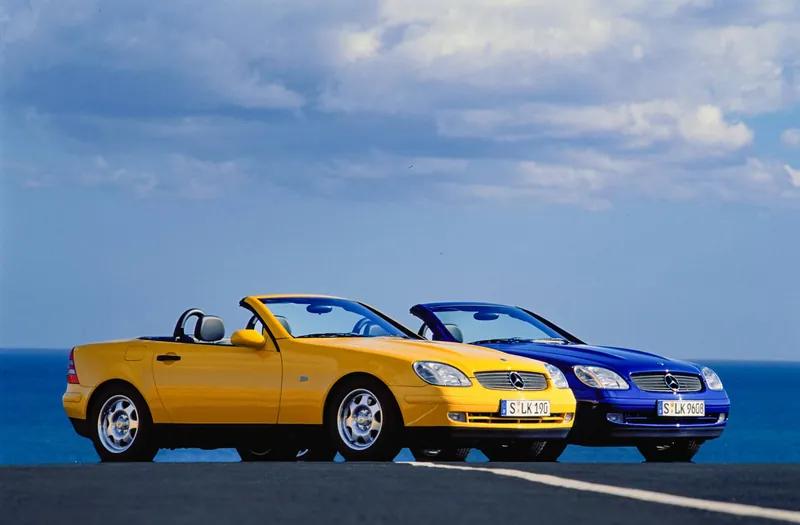
It never went on sale. Road & Track quotes Dodge's own blog from 2012, which said "corporate planners were focused on faster growing market segments at the time, reportedly, including sport utility vehicles" 3. Chrysler's 1998 merger with Daimler, which already built the Mercedes SLK roadster, made a separate Chrysler roadster harder to justify 3. There was a dispute over the name, too: Road & Track reports that ZZ Top's Billy Gibbons, who owned a hot rod called Kopperhead, complained, and Dodge began calling the car simply the Concept Car 3.
The idea did not disappear entirely. The 2003 Viper borrowed some styling cues from the Copperhead, and Dodge built 300 Copperhead Edition Vipers for 2005 in the concept's copper-orange paint 3.
Dodge Copperhead performance: 0-100 km/h and top speed
Dodge never published acceleration or top-speed figures for the Copperhead, and the show car was never tested at speed. The figures below are the ones Chrysler released. Figures marked (converted) are our conversions: 1 inch = 25.4 mm.
| Item | Dodge Copperhead | Source |
|---|---|---|
| Engine | 2.7-liter 24-valve V6, four camshafts, aluminum | C1, C2 |
| Power | About 220 hp | C2 |
| Gearbox | Five-speed manual, rear-wheel drive | C1, C3 |
| Wheelbase | 110 in (2,794 mm (converted)) | C1 |
| Tires | 225/40R18 front, 255/40R20 rear | C1 |
| Brakes | Anti-lock discs | C1 |
| Steering | Speed-sensitive power rack and pinion | C1 |
| Expected price | About $30,000 (Chrysler, 1997) | C2 |
Buying a Dodge Copperhead: what to know
- There is no Copperhead to buy. Chrysler built a single show car and never put it into production 1,3.
- The closest production cars. The Copperhead Edition Viper of 2005 wears the concept's color, and 300 were built 3. For a Chrysler roadster of the same era, look at the Plymouth Prowler, which appeared at the same 1997 Detroit show and inspired the Copperhead's proportions 1,3.
- Scale models. Road & Track notes that Maisto made a 1:18 model of the Copperhead, which remains the easiest way to own one 3.
Dodge Copperhead questions
What engine does the Dodge Copperhead have?
A 2.7-liter aluminum V6 with four camshafts, from Chrysler's 1998 LH sedans, rated at about 220 hp. 1,2
Was the Dodge Copperhead ever made?
No. It was a 1997 concept car, and Dodge dropped it in favor of faster-growing segments such as SUVs. 3
Who designed the Dodge Copperhead?
Bob Hubbach drew the first sketch, Bill Chergosky the rear and Michael Burton the interior, under design director Neil Walling. 1
Why was the Copperhead renamed?
Road & Track reports that Billy Gibbons of ZZ Top objected because of his Kopperhead hot rod, so Dodge called it the Concept Car. 3
Related cars
- Its big brother: the Dodge Viper.
- The roadster that later used Mercedes parts: the Mercedes SLK.
- Another 1990s concept: the Ford GT90.
Sources and notes
Notes on the figures
- Power. Hot Rod's 1997 show report gives 220 hp 2. Sports Car International gives a range of 220 to 250 hp 1.
- Front suspension. Sports Car International says the front arms came from Chrysler's Cirrus, Stratus and Breeze 1. Road & Track says they came from the Sebring convertible 3.
- Design inspiration. Walling named the Austin-Healey 100 and Jaguar XK120 1. Herlitz named the Austin-Healey 3000 3.
Sources
Dodge Copperhead Photos
3 photosDodge Copperhead Technical Data
Engine
| Engine | 2.7 L V6 aluminum, four camshafts |
|---|---|
| Power | About 220 hp Chrysler |
| Gearbox | Five-speed manual from the Dakota |
The car
| Wheelbase | 110 in |
|---|---|
| Built by | Metalcrafters California |
| Number built | 1 show car |
Dodge Copperhead vs rivals
Compare CopperheadCars from the same years.