Ferrari Mythos
Pininfarina took a Ferrari Testarossa, removed the roof and side windows, and wrapped its flat-12 in a lower, wider composite body with a wing that rose at speed. The Mythos stunned the 1989 Tokyo Motor Show and became the starting point for the Ferrari F50.
Ferrari Mythos key figures
Swipe for all 4 key specs →
Ferrari Mythos specs
| Specification | Figure | Source |
|---|---|---|
| Base | Ferrari Testarossa chassis, transmission, suspension, steering and brakes | Y1, Y2 |
| Engine | 4,942 cc flat-12, mid-mounted | Y1, Y2 |
| Power | 390 hp | Y1, Y2, Y3, Y4 |
| Torque | 261 lb ft (354 Nm (converted)) | Y2 |
| Gearbox | Five-speed manual, rear-wheel drive | Y1, Y3 |
| Body | Roofless barchetta in composite materials | Y2, Y3 |
| Curb weight | 1,252 kg (2,760 lb) | Y1, Y3 |
| Tires (rear) | Pirelli P Zero 335/25 ZR17 on OZ wheels | Y1 |
| 0–100 km/h | 6.2 s (claimed) | Y3 |
| Size vs Testarossa | About 3 in lower, 5 in wider and 6 in shorter | Y3, Y4 |
| Debut | Tokyo Motor Show, Makuhari Messe, 26 October 1989 | Y2, Y5 |
Ferrari Mythos history
Pininfarina's Tokyo statement
The doors of the Tokyo Motor Show at the Makuhari Messe opened on 26 October 1989, and the Mythos was waiting inside 1. With it, Pininfarina became the first independent design company to take part in the Tokyo show, and the car won the 1990 Car Design Award 2. Motor Trend reports that Pininfarina wanted to show Japan, the world and Ferrari that it still had its touch, at the height of Japan's economic boom 1.
A Testarossa without a roof
Pininfarina considered coupe, targa and speedster bodies before choosing the roofless barchetta 3. The Testarossa's 390 hp flat-12, transmission, suspension, steering and brakes were carried over, and the composite body shed 255 kg, leaving a curb weight of 1,252 kg 4. The wheelbase stayed the same, but the Mythos was about six inches shorter, nearly five inches wider and three inches lower than the Testarossa 4,3,5. Huge side intakes fed the rear-mounted radiators 4.
Moving aerodynamics
The rear wing rose by up to 30 cm and rotated by 12 degrees as speed increased, and a panel under the front bumper moved forward by about 3 cm to add downforce 4,3. Inside were two wrap-around seats, few dials and leather on almost every surface, in red or black 4.
Designers and the road to the F50
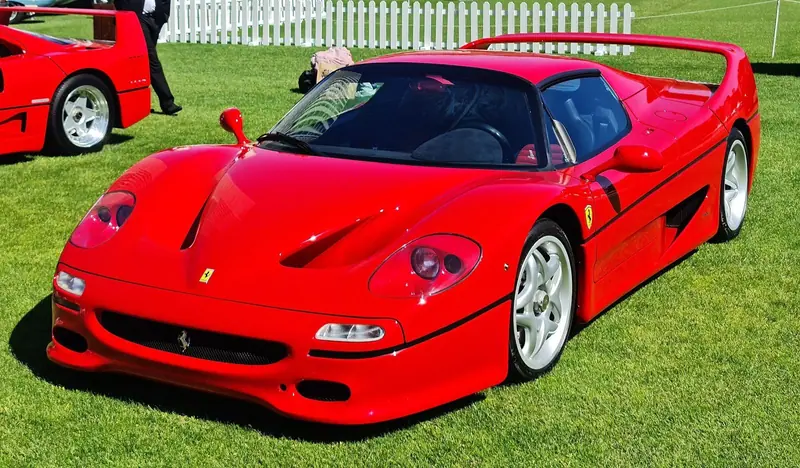
Hagerty credits Pietro Camardella and Lorenzo Ramaciotti with the design 5. Motor Trend names Camardella, who had also worked on the F40, and says he used the Mythos as inspiration for the Ferrari F50, whose body shape, rear intakes and wing echo it 1,5.
Three cars
Japanese collector Shiro Kosaka saw the Mythos at the Tokyo show and, after two years of talks, persuaded Pininfarina to sell it to him. It was shown at his Gallery Abarth museum near Mount Fuji until the museum closed in the mid-2000s, then kept at Pininfarina in Cambiano. At the 2019 Monaco concours it was driven on public roads for the first time 1. The Sultan of Brunei ordered two more for his collection, one red and one blue 1,3,5.
Can you buy a Ferrari Mythos?
No. Only three were made: the original belongs to Shiro Kosaka, and the other two were built for the Sultan of Brunei's private collection 1,3. To own something of the Mythos, look at the cars it came from and led to:
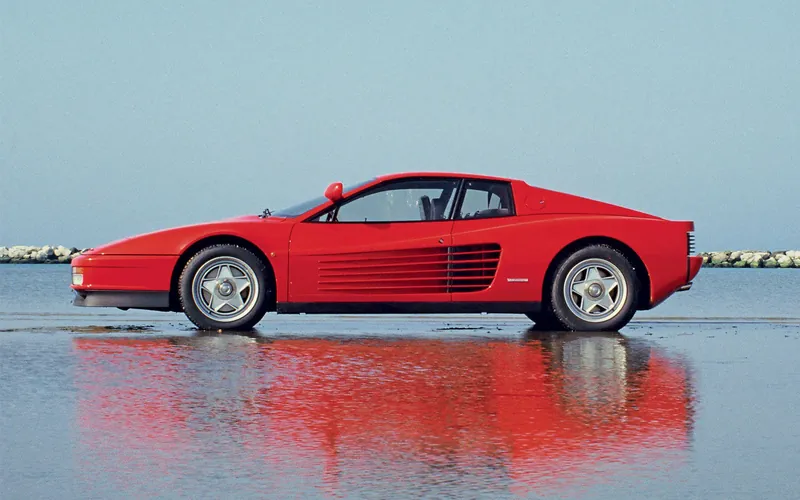
- The donor: the Ferrari Testarossa shares its flat-12, gearbox and chassis.
- The descendant: the Ferrari F50 took its shape forward into production.
- A rival of the era: the Lamborghini Diablo.
Ferrari Mythos questions
What is the Ferrari Mythos based on?
The Ferrari Testarossa, whose 4.9-liter flat-12 and running gear it uses. 4,1
How many Ferrari Mythos were made?
Three: the original show car and two built for the Sultan of Brunei. 1,3
Who owns the Ferrari Mythos?
The original belongs to Japanese collector Shiro Kosaka. 1
Related cars
- The donor: the Ferrari Testarossa.
- The descendant: the Ferrari F50.
- More Ferrari: the Ferrari make page.
Sources and notes
Notes on the figures
- Top speed. Below The Radar says about 160 mph, lower than the Testarossa because of the open body's aerodynamics 4. Motor1 gives 180 mph (290 km/h) 3.
- Designer. Below The Radar names Lorenzo Ramaciotti 4; Motor Trend names Pietro Camardella 1; Hagerty credits both 5.
- The Sultan's second car. Motor Trend and Motor1 describe it as blue 1,3; Hagerty says turquoise 5.
Sources
- Motor Trend (Automobile), "The Ferrari Mythos Is an Awe-Inspiring Forgotten Icon", Ken Saito, 8 Jul 2019
- Pininfarina, "Heritage"
- Motor1, "1989 Ferrari Mythos: Concept We Forgot", Adrian Padeanu, 23 Aug 2017
- Below The Radar, "Pininfarina Mythos", Richard Dredge
- Hagerty, "Take a detailed look at the unique Ferrari Mythos prototype", Máté Petrány, 31 Mar 2020
Ferrari Mythos Photos
6 photosFerrari Mythos Technical Data
Mechanicals
| Engine | 4,942 cc flat-12 Testarossa |
|---|---|
| Gearbox | Five-speed manual rear-wheel drive |
Aero
| Rear wing | Up to 30 cm rises and rotates 12° |
|---|---|
| Front panel | About 3 cm moves at speed |
Ferrari Mythos vs rivals
Compare MythosCars from the same years.