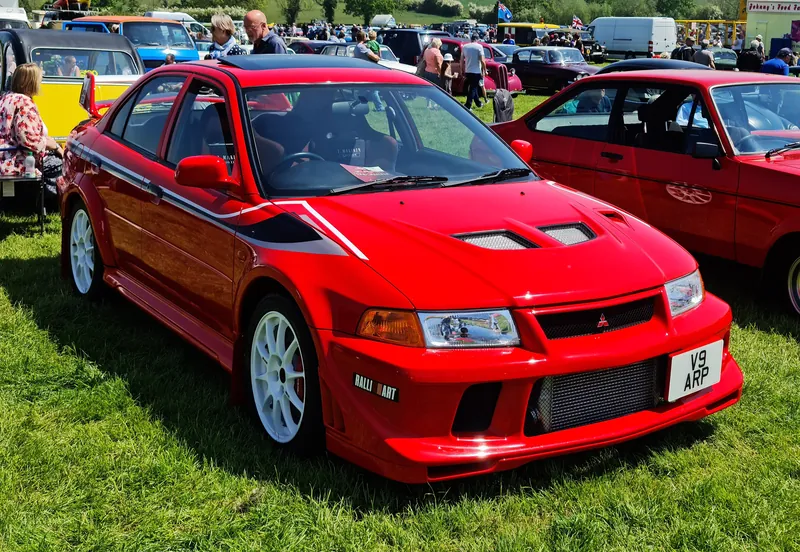
Mitsubishi Lancer Evolution VII
The seventh Evo looked calmer than the Evo VI, but it was stiffer and cleverer underneath. It was the first Evo with an electronically controlled center differential, and its body became the base for Mitsubishi's first World Rally Car.
Mitsubishi Lancer Evolution VII key figures
Swipe for all 4 key specs →
Mitsubishi Lancer Evolution VII specs
- Engine: 4G63 2.0-liter (1,997 cc) turbocharged four-cylinder, 280 PS at 6,500 rpm and 39.0 kgm (383 Nm) at 3,500 rpm in Japanese GSR form. 1,2
- Drivetrain: five-speed manual and full-time all-wheel drive with ACD (Active Center Differential) and AYC (Active Yaw Control), run by one computer. 3,4
- Chassis code: CT9A. 5
- Size and weight: 4,455 mm long, 1,770 mm wide, 2,625 mm wheelbase. The Japanese GSR weighed 1,400 kg. 1
- Performance: 0–60 mph in 5.0 seconds and 140 mph in an evo magazine test of the 276 bhp car. 6
- On sale: Japan, 3 February 2001. Replaced by the Evo VIII in January 2003. 2,7
- Price new: ¥2,998,000 for the GSR in Japan, less than the Evo VI GSR. £29,995 in the UK. 1,3,6
Mitsubishi Lancer Evolution VII history
A new base car
Every Evo up to the Evo VI Tommi Mäkinen Edition was based on the small Lancer. In May 2000 Mitsubishi replaced it with the Lancer Cedia, a larger and more sober car that did not look like rally material 3. Mitsubishi announced the Evo VII on 26 January 2001 and put it on sale on 3 February 2.
The Cedia brought a longer wheelbase and a wider track 8. The wheelbase was 115 mm longer than before 1. To stop the weight from rising, Mitsubishi used aluminum for the hood and front fenders, thinned the roof panel and cut the thickness of the door glass by 10 per cent. The GSR ended up only 40 kg heavier than before, and the stripped-out RS 60 kg heavier 1. The body was also much stiffer. Mitsubishi added 20 extra reinforcements, more spot welds around the door openings and a strut-tower brace 3, and claimed 50 per cent more bending stiffness 1,6.
The engine
The 4G63 stayed, but with a reworked turbocharger, a larger intercooler with a three-nozzle water spray, a hollow camshaft and a magnesium rocker cover in place of aluminum 3. Peak power stayed at 280 PS, the limit Japanese makers observed at the time. Torque rose by 1 kgm to 39.0 kgm at 3,500 rpm, with more pull between 2,750 and 5,500 rpm 1. Mitsubishi shortened first gear, made fifth taller and strengthened the clutch 3.
ACD: the new center differential
The big change was in the drivetrain. Earlier Evos used a viscous coupling in the center differential. The Evo VII replaced it with ACD, an electronically controlled multi-plate clutch 3,2. ACD keeps the 50:50 front-to-rear split, but it can vary how strongly the center differential locks, from fully open to fully locked 2. A dashboard switch offered three modes: Tarmac, Gravel and Snow 3. Pulling the handbrake freed the center differential almost completely, so competitors could still do handbrake turns 3.
Mitsubishi also strengthened the AYC rear differential, which had first appeared on the Evo IV, to cope with the extra torque. It merged the AYC and ACD computers, hydraulic units and sensors into one system 4.
Rallying: the Evo 6.5 and the first WRC car
The Evo VII arrived as Mitsubishi was switching from Group A cars to World Rally Car rules. Tommi Mäkinen started the 2001 season in the Group A Evo VI, the car known as the "Evo 6.5". Mitsubishi's first World Rally Car, the Lancer Evolution WRC, made its debut at Rally Sanremo in October 2001 9. It used the Evo VII as its base car 3. Mitsubishi says the development time was not enough. The WRC car finished only once that season, and most of Mäkinen's points that year came from the Group A car 9.
The UK cars
Before official UK cars arrived, Evo VIIs came to Britain as gray imports 7. Official UK cars had a titanium turbo, full rustproofing and an ECU remapped for UK emissions rules 7. The Ralliart range included the RS Sprint, the Extreme (339 bhp) and the Extreme S (357 bhp). In 2002 Mitsubishi simplified the range to the GSR and the 305 bhp FQ-300 7. The FQ-300 got its extra power from a 75 mm exhaust and a high-flow air filter, with no change to the engine software 10. An automatic version, the GT-A, was announced in January 2002 7.
Mitsubishi Lancer Evolution VII performance: 0-100 km/h and top speed
| Item | Evo VII GSR | Source |
|---|---|---|
| Engine | 4G63, 1,997 cc, turbocharged inline-4 | V4, V8 |
| Power (Japan) | 280 PS at 6,500 rpm | V3 |
| Power (UK) | 276 bhp at 6,500 rpm | V8 |
| Torque | 39.0 kgm at 3,500 rpm (Japan); 383 Nm; 282 lb ft (UK) | V3, V5, V8 |
| Gearbox | 5-speed manual | V5 |
| Drive | 4WD, ACD + AYC, 50:50 nominal split | V4, V5 |
| Length × width × height | 4,455 × 1,770 × 1,450 mm | V3 |
| Wheelbase | 2,625 mm | V3 |
| Weight | 1,400 kg (Japan GSR); 1,360 kg (UK) | V3, V8 |
| Tires | 235/45 ZR17 | V5 |
| 0–60 mph | 5.0 s (tested) | V8 |
| Top speed | 140 mph (tested); 180 km/h (112 mph) limiter on Japanese cars | V7, V8 |
| FQ-300 | 305 bhp, 300 lb ft, 0–62 mph 5.1 s (claimed), 157 mph limited | V8, V9 |
| Price new | ¥2,998,000 (GSR, Japan); £29,995 (UK) | V3, V8 |
Buying a Mitsubishi Lancer Evolution VII: what to check
- Rust first. ReDriven advises getting the car on a lift and checking the chassis rails, front crossmember, rear subframe and strut tops. If you find rust, walk away 5.
- Check it is what it claims to be. Ralliart dealers admit that any Evo VII can be made to look like another version 7. The RS has black door handles and mirrors, no rear wiper or fog lights, usually steel wheels, and came only in Scotia White 7.
- Imports. Check the rust protection, rear fog light, removal of the 112 mph limiter and the mph speedometer conversion 7. Look for worn pedals, carpets and seat bolsters that do not match the mileage, which can mean a swapped instrument cluster 5.
- ACD and AYC. Turn the key and check that the ACD lights work and change with each mode 5. AYC and ACD pumps fail when they are not serviced, and diagnosing AYC needs Mitsubishi's MUT-II tool 7,5.
- Drivetrain. The Evo VII's transfer case and lower engine are known to be weak in heavily modified cars. ReDriven recommends an Evo VIII or IX for big power 5. Check that the timing belt has been changed on time, and look for coolant overflowing because of a poorly sealing expansion-tank cap 5.
- Standard cars are worth more. Aftermarket fuel-cut defencers and cable ties around the turbo hoses are signs of extra boost 7. ReDriven recommends paying more for the most original, best-documented car you can find 5.
Mitsubishi Lancer Evolution VII questions
How much horsepower does the Evo VII have?
The Japanese GSR has 280 PS at 6,500 rpm. The UK GSR is rated at 276 bhp, and the FQ-300 at 305 bhp. 1,6,10
What is ACD on the Evo VII?
ACD is the Active Center Differential. It is an electronically controlled clutch that varies how strongly the center differential locks, with Tarmac, Gravel and Snow modes. The Evo VII was the first Evo to have it. 3,2
What is the Evo VII chassis code?
CT9A. The Evo VIII and IX use the same platform. 5
How fast is the Evo VII?
evo magazine recorded 0–60 mph in 5.0 seconds and a top speed of 140 mph. 6
Is the Evo VII a sedan?
Yes. It is a four-door sedan based on the Lancer Cedia. 3,7
Related cars
- The whole family: our Mitsubishi Lancer Evolution guide.
- The car it replaced: the Evo VI Tommi Mäkinen Edition.
- Its rival: the Subaru Impreza WRX, which also got a new body in 2000.
- Another Japanese all-wheel-drive icon: the Nissan Skyline GT-R R34.
Sources and notes
Notes on the figures
- Torque. Japanese sources give 39.0 kgm 8,1 and 383 Nm 2. evo gives 282 lb ft (382 Nm) for the UK car 6. The figures match within rounding.
- Weight. webCG gives 1,400 kg for the Japanese GSR 1. evo lists 1,360 kg 6.
- WRC debut. Mitsubishi says the Lancer Evolution WRC first ran at Rally Sanremo in October 2001 9. Web Motor Magazine says it was used from round 10 2. Meisha says round 11 3.
Sources
- webCG, "三菱ランサーエボリューションVII GSR(5MT)【試乗記】", 25 Apr 2001
- Web Motor Magazine, "ランサーエボリューションⅦ登場", 26 Jan 2018
- 名車文化研究所 (Meisha), "ランサー・エボリューションVII"
- Response.jp, "【ランエボ7デビュー】アクティブ・ヨー・コントロール(AYC)も大幅強化し、ACDとリンク", 26 Jan 2001
- ReDriven, "Used Mitsubishi Lancer Evolution VII – IX review", Adam Morris, 13 Dec 2021
- evo, "Mitsubishi Lancer Evolution VII - review, history, prices and specs", Antony Ingram, 3 Jul 2017
- RAC Drive, "Mitsubishi Lancer Evo VII (2001 - 2003) used car review"
- Mitsubishi Motors Thailand, "The Mitsubishi Lancer Evolution VII", heritage page
- Mitsubishi Motors, "2001 World Rally Championship"
- PistonHeads, "Evo VII FQ-300", Graham Bell, 17 Oct 2002
Mitsubishi Lancer Evolution VII Photos
7 photosMitsubishi Lancer Evolution VII Technical Data
Engine and drivetrain
| Engine | 4G63 2.0 L turbo 1,997 cc |
|---|---|
| Power | 280 PS 6,500 rpm |
| Torque | 39.0 kgm 3,500 rpm |
| Gearbox | 5-speed manual ACD + AYC |
Body
| Wheelbase | 2,625 mm |
|---|---|
| Weight | 1,400 kg Japan GSR |
| Price new | ¥2,998,000 GSR |
Mitsubishi Lancer Evolution VII vs rivals
Compare Lancer EvolutionCars from the same years.