TVR Speed 12
TVR built the Speed 12 to take on the McLaren F1 in GT racing, with a 7.7-liter V12 made from two of its own straight-sixes. The racing plan collapsed, and Peter Wheeler canceled the road car after one drive home. One road car was finished anyway, and in 2023 it sold for £601,500, a record for a TVR.
TVR Speed 12 key figures
Swipe for all 4 key specs →
TVR Speed 12 specs
- Engine: 7.7-liter (7,730 cc) V12 with a fabricated steel block, in effect two TVR straight-six engines on one crankshaft. 1,2,3
- Power: 800 bhp quoted by TVR for the road car; the one finished road car is quoted at 840 bhp by its auctioneer and 880 bhp by evo. 2,3
- Chassis: tubular steel spaceframe with an integrated roll cage on the first car; the Cerbera Speed 12 added folded aluminum and honeycomb. 2
- Body (road car): carbon-fiber and Kevlar, from one of the GT racing cars. 3
- Weight: 1,100 kg (TVR Car Club and the auctioneer). 1,3
- Wheelbase: 2,640 mm; length 4,360 mm; width 1,960 mm. 1
- Price (planned, 2000): £245,000. 4,3
- Built: one finished road car (W112 BHG), plus show cars, prototypes and racing cars. 2,3
TVR Speed 12 history
Project 7/12
The Speed 12 started with an argument between TVR boss Peter Wheeler and engineer John Ravenscroft about cylinder heads for TVR's new straight-six. It ended with a decision to build a V12 2. Wheeler had seen the McLaren F1 succeed in GT racing and wanted a GT1 car of his own, but TVR could not afford to cast a new aluminum block. Instead it fabricated one from steel 2. A purple road-car mock-up called Project 7/12, for 7.7 liters and 12 cylinders, appeared at the NEC Motor Show in October 1996. TVR claimed 660 bhp and took deposits, including from Keith Flint and Liam Howlett of The Prodigy 2.
Racing plans change
By the time a running car reached Snetterton in 1998, renamed Speed 12, Porsche and Mercedes had arrived in GT1 with big-budget, purpose-built cars 2. The FIA's rules also restricted the engine to about 675 bhp with intake restrictors 3. After a few outings the GT1 car was obsolete, and Wheeler canceled the program. evo notes that TVR still made money by licensing the design to Scalextric and video games, including Gran Turismo 2,3.
The 960 bhp story
TVR built a new car, the Cerbera Speed 12, for GT2 racing and a road version. It said the engine was too strong for its 1,000 bhp dyno, so each bank was tested separately and made 480 bhp, implying 960 bhp in total 2,3. TVR's official figure for the road car was 800 bhp, at a planned price of £245,000 3. evo, advised by former TVR staff, says the reality was less dramatic: the engine probably snapped the dyno's input shaft 2.
Too much for the road
The racing car won the Silverstone round of the 2000 British GT Championship in the rain. It won two more races in 2001 and reached the podium in seven of 12 rounds in 2002 2. On the road side, Wheeler drove a finished prototype home one evening and canceled the road car. "I knew within 300 yards that it was a silly idea," he said later. "Over 900bhp in a road car weighing just over a ton is plainly ridiculous" 2. evo adds that the car was also very wide, had poor steering lock and needed tires TVR could not easily source. Deposits were returned and the prototypes were broken up for racing spares 1,2.
The one road car
In August 2003 TVR advertised a Cerbera Speed 12, registered W112 BHG, for sale, and Wheeler personally vetted the buyer 1,2. A small team of TVR race engineers then spent more than two years building it from the best remaining parts, using the carbon-Kevlar shell from one of the racing cars and the original 7.7-liter V12. It was finished in 2005 3. When John Barker drove it for evo in 2005, he called it "terrifyingly, crazily quick". It remains the only car to score 11½ in evo's five-star rating system 2.
TVR Speed 12 performance: 0-100 km/h and top speed
TVR never released verified acceleration or top-speed figures. Its claim that the car could exceed 240 mph was never tested 1, and the TVR Car Club lists a 0–60 mph time of 2.9 seconds as unconfirmed 1. The figures below are the ones the sources agree were quoted or measured.
| Item | Figure | Source |
|---|---|---|
| Engine | 7,730 cc V12 | TS1 |
| Power, Project 7/12 show claim (1996) | 660 bhp | TS2 |
| Power, GT1 racing (restricted) | about 675 bhp | TS1, TS4 |
| Power, road car (TVR official) | 800 bhp | TS4 |
| Power per bank on the dyno | 480 bhp | TS2, TS4 |
| Weight | 1,100 kg | TS1, TS4 |
TVR Speed 12: what to know
There is only one TVR-built Speed 12 road car, so this is not a car you can shop for in the usual way.
- The real car. W112 BHG last sold through Silverstone Auctions on 20 May 2023 for £601,500, a record for a TVR 3,5. Any future sale is likely to be a similar auction event.
- Lookalikes. A later owner used leftover factory parts to build a second car with an Aston Martin V12. Helical Technology has built two similar-looking cars with Aston V12s 2. None has the TVR V12, so none should be sold as a factory Speed 12.
- The closest production TVR. The Speed 12's engine was two TVR straight-sixes joined together 1. The production Cerbera Speed Six, with the same family of engine and the same Wheeler-era character, is the realistic way to own part of this story.
TVR Speed 12 questions
How much horsepower does the TVR Speed 12 have?
TVR quoted 800 bhp for the road car. The one finished road car is quoted at 840–880 bhp, and dyno tests of each bank suggested up to 960 bhp. 2,3
How many TVR Speed 12s were made?
TVR finished one road car, W112 BHG. Show cars, prototypes and racing cars were also built, and most were broken up. 2,3
Why was the TVR Speed 12 canceled?
Peter Wheeler drove a prototype home and decided it was too powerful for the road. It was also very wide, had poor steering lock and needed hard-to-source tires. 2
What did the TVR Speed 12 sell for?
£601,500 at Silverstone Auctions in May 2023, a record for a TVR. 3,5
What engine is in the TVR Speed 12?
A 7.7-liter V12 with a steel block, made by joining two TVR straight-six designs. 1,2
Related cars
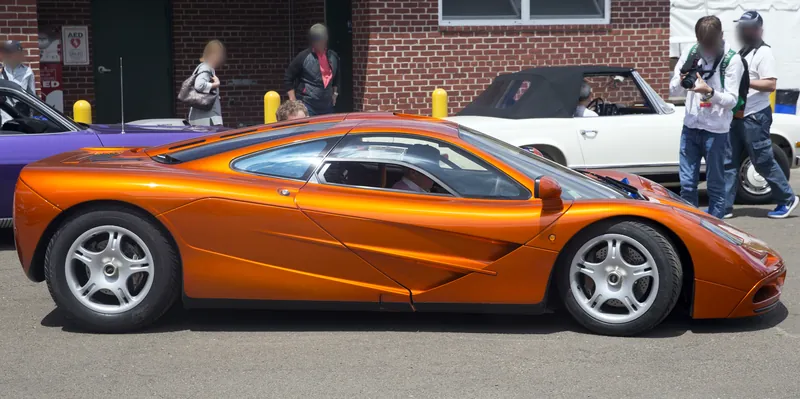
- The car it was built to beat: the McLaren F1.
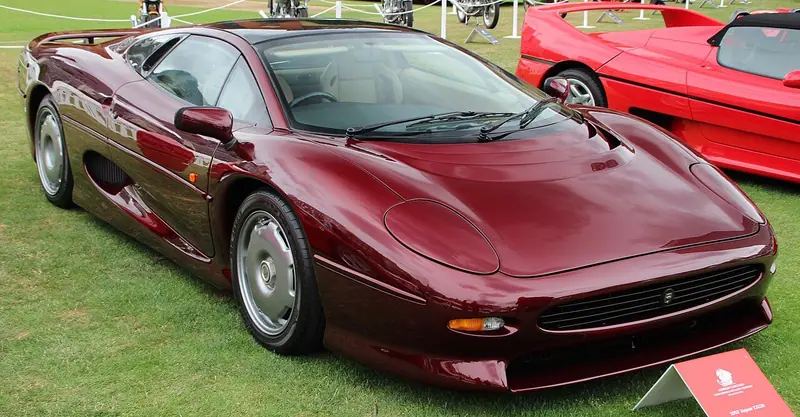
- Another British supercar of the 1990s: the Jaguar XJ220.
Sources and notes
Notes on the figures
- Power of the finished road car. The auctioneer quotes 840 bhp 3. evo says 880 bhp after the owner fitted milder road camshafts 2. Top Gear says around 850 bhp 5.
- Planned price. The auctioneer and Great British Sports Cars give £245,000 4,3. The TVR Car Club gives £188,000 1.
- Weight. The TVR Car Club and the auctioneer give 1,100 kg 1,3. Top Gear says about 1,000 kg, and Great British Sports Cars says under 1,000 kg 4,5.
- The prototypes. evo says the red W112 BHG was the silver prototype W312 BFV, resprayed and re-registered 2. Great British Sports Cars lists W312 BFV as a separate purple car with an Aston Martin V12 4.
Sources
- TVR Car Club, "TVR Speed 12 details"
- evo, "TVR Cerbera Speed 12 – dead on arrival", Richard Porter, 27 August 2025 (with former TVR PR chief Ben Samuelson and engineers John Ravenscroft and Neill Anderson)
- Silverstone Auctions (Iconic Auctioneers), Lot 846, "2000 TVR Cerbera Speed 12", Supercar Fest Sale, 20 May 2023
- Great British Sports Cars, "TVR Cerbera Speed 12: the 800bhp beast too fast for the road"
- Top Gear, "One-off TVR Cerbera Speed 12 sold at auction for record-breaking price of £601,500", Craig Jamieson, 22 May 2023
TVR Speed 12 Photos
6 photosTVR Speed 12 Technical Data
Engine
| Layout | V12 two straight-sixes |
|---|---|
| Capacity | 7,730 cc steel block |
| Power | 800 bhp TVR road figure |
The car
| Body | Carbon-Kevlar from a GT racer |
|---|---|
| Weight | 1,100 kg quoted |
| Sold | £601,500 May 2023 |
TVR Speed 12 vs rivals
Compare Speed 12Cars from the same years.